


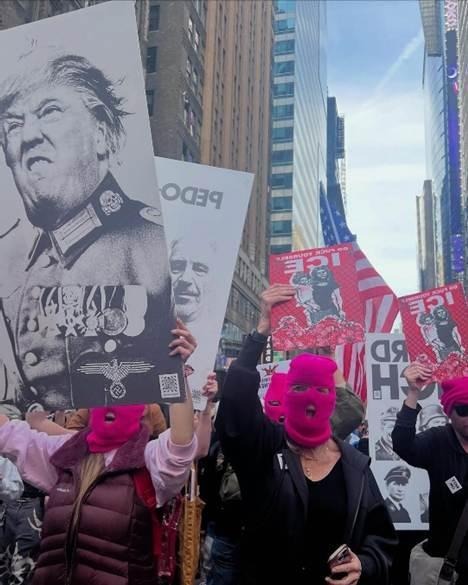
When I was 17, one of my photographs was curated into a group art show exhibiting “female rage” over Trump’s 2017 inauguration. Being selected to take part in “Uprise: Angry Women”, a group show at a Tribeca art gallery, was a huge source of adolescent pride. I had officially joined the ranks of the feminist artivism movement in America. I would be following in the steps of my then-heroes Pussy Riot and using fashionable protest aesthetics as my praxis in waging cultural war upon Tsar Putin’s domination of my beloved Russia. [The American feminist artist Molly Crabapple, who created the ICE protest signage used in the No Kings NYC Pussy Riot protest in the images above, would later exhibit her work in a solo show at the same gallery and would attend the opening of that show.]
At the time, idolizing Pussy Riot was part of my adolescent rejection of my Russified American suburban intelligentsia childhood. It was a protest against my continual feelings of never fully belonging to either one of my ancestral cultures. In Moscow I felt that I was a “fake Russian”- an American who had never held a Russian passport. I was in the Russian capital in 2012, the year that Pussy Riot enacted their seminal and deeply controversial “Punk Prayer” performance in the Cathedral of Christ the Savior. Aesthetically, I was enthralled. As a 13-year-old, all of my family’s conversations about the Kremlin’s supposed evilness meant absolutely nothing to me until I saw Nadya Tolokonnikova’s pretty headshot on the front page of the Russian newspaper Kommersant laying on my grandmother’s kitchen table. I would catch snippets of their “Putin Pissed Himself” performance in short colorful dresses and ski masks in the middle of the 15°F Moscow winter on TV. Recordings of their performances and images of the group members were shown on every news channel in Russia that year. The Putin regime clearly understood that the righteousness of their imprisonment would serve as a uniquely unifying topic between the Russian professional managerial class and working classes. The group’s Western feminist rhetoric made both liberal and nationalist Russian women deeply uncomfortable.
I can vividly recall the theatrical indignation of my family - which is for the most part comprised of liberal minded academics- at the stunt’s “hooliganism” and “audacity”. There was a sort of general hysteria around how the group’s two founding members (Nadya and Masha) came out of elite educational backgrounds. One was studying philosophy at the prestigious Moscow State University. The other was the daughter of a mathematics professor and a student of two well-known contemporary Russian poets. Within the academy, the general feeling was that the American style Guerilla Girl protest ideals were corrupting Russian University systems. Part of an insidious plot to import an American style cult of celebrity to Russian students. A plot to signify the end of native Russian institutional meritocracy and prestige. I also remember the comments that the elderly neighbors in our university-subsidized apartment building (housing for professorial families) made to my mother about her moral responsibility as a Russian woman. They would shame her for abandoning the motherland in order to raise her daughter in a country that promoted such a deeply vulgar form of feminism. And I also remember how my grandmother, who was hardly religious, delivered a long lecture on how spiritually corrupt those Pussy Riot girls were in order to disrespect such an important house of worship. My grandmother was incensed by how clumsily the Pussy Riot girls would cross themselves. That was despite the fact that my grandmother was a relatively recent post-Soviet convert to Russian Orthodoxy herself.
The international delirium of the 2012 Pussy Riot trial occurred in the largest city in all of Europe, just as Russia declared its cultural war against the West. It was in fact a masterful guerilla performance art piece meant for the Western world. The Pussy Riot girls would survive their terms in the notoriously harsh Russian penal colonies by employing American punk protest tactics. Within a globalized context these would garner international support from liberal elites in Europe and America alike. Although Pussy Riot was originally designed to represent the interests, tastes, cultural prejudices, and desires of the Moscow middle class intelligentsia, it found its most enduring audience in the West as part of a quickly internationalizing globalization of the symbols and semiotics of opposition movements to globalized tyranny and authoritarianism. Their words (however primitive) and performance (a slightly-more complexly-embodied text) were powerfully subversive. Whilst they were ultimately plagued by the same critiques of the Slavoj Zizek style fashionable Left, the incredible innovation of Pussy Riot was its importation to Russia a Western-style activism. This was an excellent way to garner the support of global audiences. On a macro level, they brought gendered opposition tactics to Russian politics. These were based on American conceptual art, American feminism, and Western forms of protest art. On a localized level, they applied Western and American forms of feminism to post Soviet Russian culture in a very sophisticated manner. In the process acquiring social capital with both the (highly) educated Russian diaspora and the Westernized hipsters in the urban city centers, Pussy Riot’s mastery of culture jamming would grant them personal survival in exile. And yet, the transculturation that occurred in the process would also rob them of any historical or cultural continuity and would lead to the political flattening of their aesthetic. The critique of that process would provide fuel to the various nationalist narratives of “the Feminist movement, the human rights community, and rebel musicians who proclaim themselves defenders of free speech in the West.”
As a Russian-American I have spent the last decade observing the emergence of striking similarities between the degradation of Russian democratic norms and those in the liberal democratic United States. Similarities that need to be better explained to American liberals. What is to be learned from Pussy Riot’s dissidence?
While their work is generative and remains of great interest to global audiences, the success of their protest actions in Moscow was entirely due to their mastery of the grammar of the Russian opposition movement. Even so, since their release from Russian prison in 2013, founding members Maria Alekhina and Nadezhda Tolokonnikova have shifted gears to almost solely producing American political commentary -beginning with their “Make America Great Again” music video released in 2016.
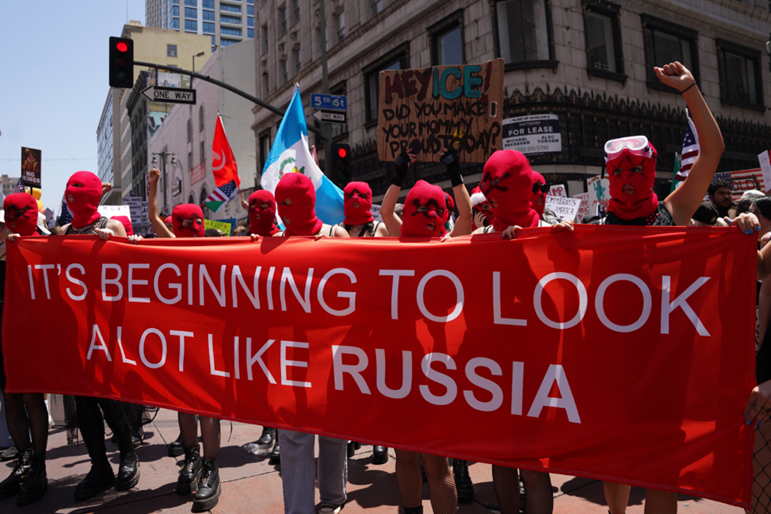
In June 2025, Pussy Riot landed in the trending section of Rolling Stone Magazine by showing up to the Los Angeles No Kings Rally with the banner “It’s Beginning To Look a Lot Like Russia” (riffing off of the Christmas song). Without hesitating the liberal American media smothered them with attention - inveighling on Americans to “believe them.” Here, the transmutation of their politics into American political commentary existed outside of the local sociocultural and historical context that had made their original protest actions so powerful. The group had very successfully codified their symbolic protest language, semiotic set of principles, and a symbolic set of opposition memes. By the time that this American export to Russia had been re-exported back to America in the time of Trump, they didn’t even actually need to say anything anymore. Merely showing up at the No Kings Rally made everyone understand their implicit point.
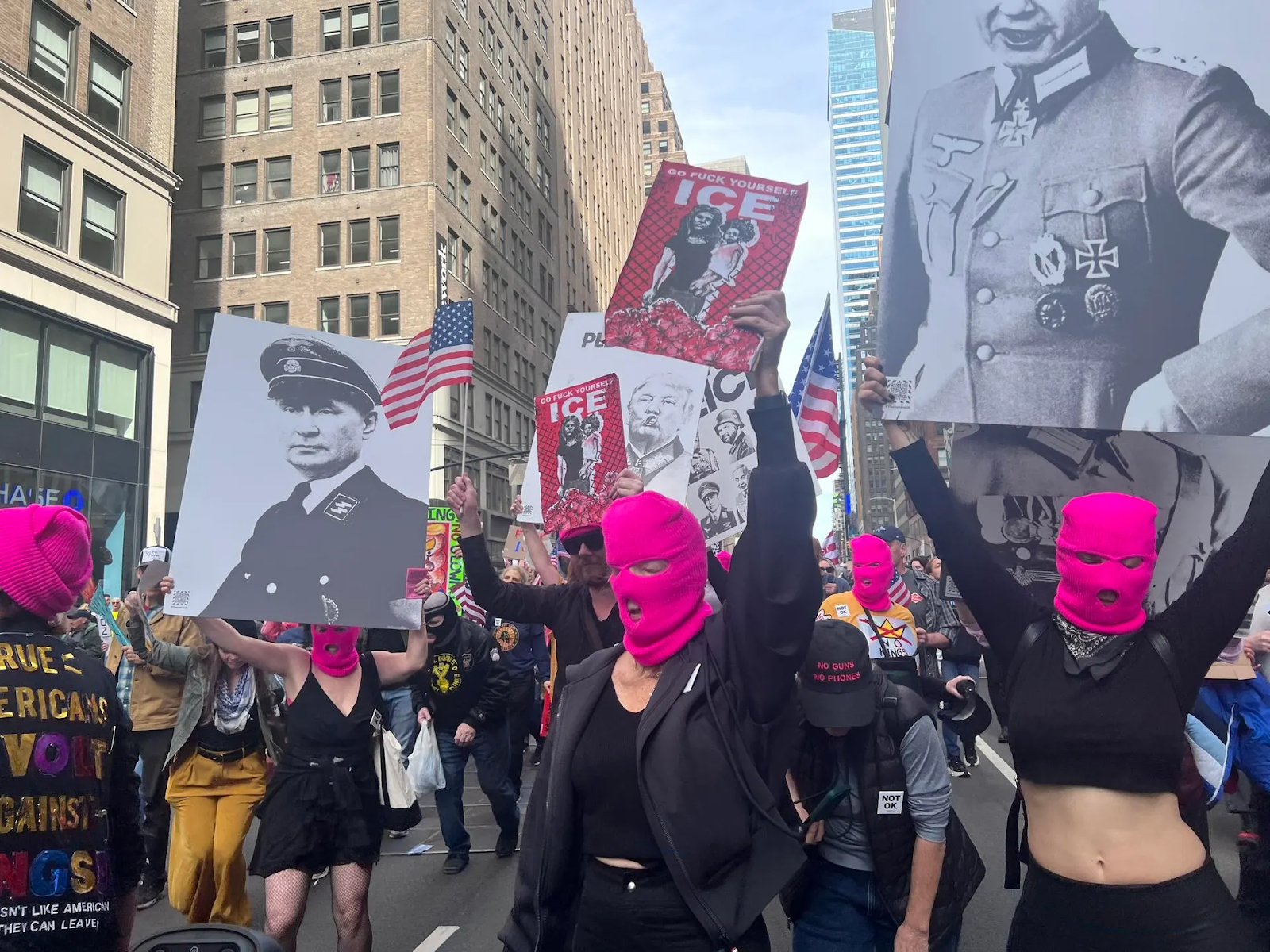
Pussy Riot’s attendance at the New York City No Kings protest on October 18, 2025 was a particularly good example of this. I was in attendance and saw the Pussy Riot column organized by a local New York City activist during the march. The group has been franchised. Merely holding up a set of placards with no particular ideological slogan specific to this moment had caused their audience to instantly understand what was meant. The symbolic semiotic system had been so deeply embedded in the syntactic sense-making apparatus of Western liberalism that people automatically started applauding Pussy Riot for merely showing up. This was a similar process to the way in which the militant aesthetics of the “turn to language” Language poets of the 1970s were absorbed by the U.S. academy as an aesthetic rather than a praxis; Pussy Riot had gotten lost in the American supermarket.
Pussy Riot now represents a globalized set of opposition practices that are understandable to liberal middle class and upper middle class women alike. In the words of the activist who organized the Manhattan column, "We showed up as Pussy Riot because they’re proof you can’t stop rebellion. Putin tried — and they only got louder. Trump’s America is just another face of the same authoritarian machine.” With these appearances, Pussy Riot effectively brings socialite Russian opposition politics to American cultural capitals, where it allows the upper middle class women to participate in dissent symbolically rather than materially. This stands in contrast to populist movements such as Putinism and Trumpism, both of which frame themselves as voices of the “ordinary” citizen against globalized elites (Putinism claims to represent the ordinary man in Russia in the same exact way in which Trumpism claims to speak for the ordinary common sense of the left out normal American). Read together, these movements form part of a transnational political ecosystem, one in which protest aesthetics function as an early warning system against creeping authoritarianism. And yet, the fact is that upper middle class and elite Russian women in the globalized West have a lot more in common with each other than they do with the Russian political system itself (even as oppositionists or system supporters). A fact which is best expressed by NYTimes reporting on how the Russian oligarch Roman Abramovich’s ex-wife Dasha Zhukova found herself at the same gala as Pussy Riot co-founder Nadya Tolokonnikova (as they often do on the social circuit in London, Paris, and New York).
On the one hand, their internationalized brand of feminism has been radically successful in raising consciousness worldwide about the arbitrariness and brutality of the Putin regime. However, they have been turfed out of Russian politics and have no influence on internal Russian politics. They are part of a Russian political movement that existed 10 years ago. To the extent that there is currently any political opposition movement within Russia - it is certainly not them. They are now a free-floating agent of internationalized dissident politics. An internationalized social media phenomenon.
As of December 2025, the Russian Ministry of Justice has added Pussy Riot to its list of extremist organizations, thus making Googling their actions in Russian illegal and rendering most of their content inaccessible. The Kremlin has therefore rendered them outside of the bounds of the Russian dialogue. The social phenomenon of Pussy Riot is now fully outside of the Russian political discourse. Instead, it functions as a portable aesthetic of popular dissent whose circulation within Western liberal spaces reveals more about the symbolic consumption of opposition than it does about the material conditions of resistance under actually existing authoritarian rule.
